|
BAR |
|
|
|
BAR 1918 |
 |
|
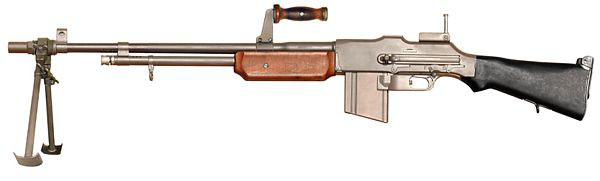
BAR1918A2 |
|
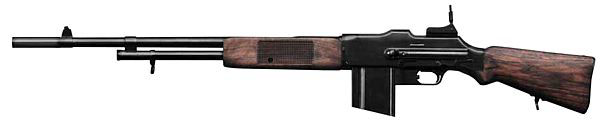
The BAR is a gas-operated, air-cooled, magazine-fed
automatic rifle that fires from an open bolt. As built for the U.S.
military, the BAR was chambered for the standard service round of that
period, the .30-06 Springfield. It weighed from 16 to 19 pounds (7.3
to 8.6 kg) empty, depending upon the model. The barrel is screwed into
the receiver and is not quickly detachable. The magazine was a
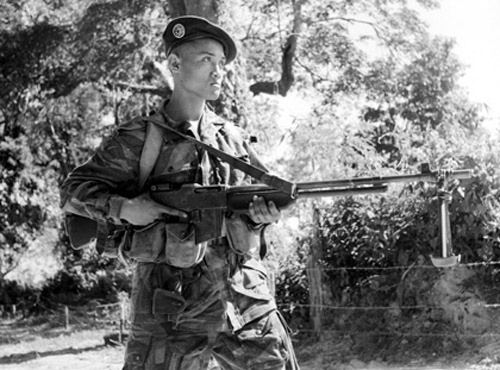
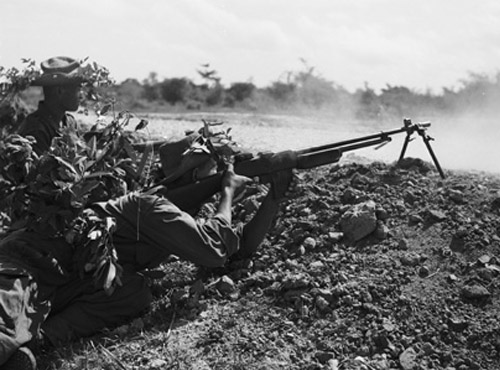
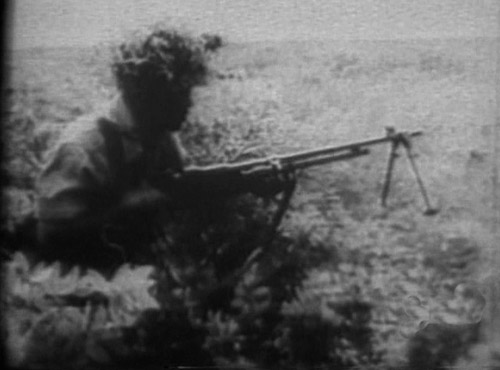
detachable box-type model with a capacity of 20 rounds. The BAR M1918 was a selective fire automatic rifle allowing the user to choose either semi or fully automatic fire. The BAR saw little action in WWI, in part due to the Armistice, in part because the U.S. Army was reluctant to have the BAR fall into enemy hands, its first action being in September of 1918. Eighty-five thousand BARs were built by the war's end. In 1922, the M1922 BAR was introduced. This version was equipped with a flanged or finned barrel and side-mounted sling swivel, and was intended for use by the U.S. Cavalry. The M1922 had no bipod as issued, although one could be fitted if desired. In June 1937, a small number of M1918s were modified to include a spiked bipod attached to the gas cylinder and a hinged buttplate. These weapons were designated M1918A1. In 1940, the final BAR model, the M1918A2 was introduced. This model did away with the semi-automatic fire option in favor of fully automatic fire only. The rate of fire was adjustable, with a choice between "fast-auto" (500–650 round/min) and "slow-auto" (300–450 round/min). This was accomplished by the use of a highly complicated recoil buffer mechanism that was difficult to clean, and often proved susceptible in service to damage from moisture and corrosion, often rendering the weapon inoperable. The (unspiked) bipod was now attached to the barrel, a flash hider was added, a rear monopod was hinged to the butt, and the weapon's role was changed to that of a squad light machinegun. Its success in this role was mixed at best, since the BAR's fixed non-replaceable barrel and small magazine capacity greatly limited its utility in comparison to genuine light machineguns such as the Bren or the Japanese M1936 Nambu. The bipod and flashhider, being easily removable, were often discarded by troops to save weight and improve the portability of the BAR. In combat, particularly in the Pacific theatre of war, the BAR effectively reverted to its original role as a portable, shoulder-fired automatic rifle. In 1942, a fiberglass buttstock replaced the wood version, and late in the war, a barrel-mounted carrying handle was added. While not without its design flaws (a
thin-diameter, fixed barrel that quickly overheated, limited magazine
capacity, complex field-strip/cleaning procedure, unreliable recoil
buffer mechanism, a gas cylinder assembly made of corrosion-prone
metals, and many small internal parts), the basic BAR design
nevertheless proved itself when kept clean and earned a reputation as
being rugged and reliable. It served as a frontline standard weapon
from the latter days of World War I through World War II, and was
pressed into use in the Korean War as well.
|
|
|
 |
 |